Let your senses guide you to this decadent chocolate cheesecake, made from Belgian chocolate and Baileys Irish Cream, on a crust of crushed chocolate cookies. One little slice goes a very long way.

Recipe, instructions, and pictures below. Click on pictures to enlarge.
Time required: 2 days (overnight chilling)
Yields: one 7″ cheesecake, with 16 portions
Cost per slice: $2.75
Total cost if you have none the required ingredients: $61.00
This post is to commemorate my first cheesecake. I had 2 goals: create my own recipe, and make a cake without cracks. Lofty goals indeed!
I hit up the St. Lawrence Market to re-stock my supply of Belgian chocolate. I buy my hard-to-find ingredients at Domino Foods, they sell delicious Callebaut chocolate. As for the pan, you don’t actually need a springform pan to make cheesecake, but it makes things easier, and those pans can also be used for other delicate desserts. I have four sizes; 9″, 7″, 6″, and 4″. I consulted Older Sister 2 for some advice, and got started.
Special kitchen implements I used:
- electric beaters
- frosting knife or thin blade
- 7″ springform pan
- parchment paper, plastic wrap, & heavy tinfoil
- 9″ x 13″ deep baking pan

Crust ingredients:
- 1¼ C chocolate cookie crumbs
- 5 TBSP unsalted butter, melted
Filling ingredients:
- 2 blocks of cream cheese, softened
- ½ C granulated white sugar
- 2 large eggs, at room temp
- 1 TSP vanilla bean paste
- 4 oz of Callebaut semi-sweet chocolate, melted
- ¼ C Baileys Irish cream
Good to know before you start:
Some recipes, including this one, require that the crust be baked at a higher temperature, and once the filling is added it’s baked at a lower temperature. Don’t forget to adjust the oven heat.
Cheesecake will collapse and crack if exposed to sudden temperature changes, don’t open the oven door during baking, and don’t place the finished cake in a drafty area to cool. (A cracked cheesecake tastes fine.)
Never insert a knife or toothpick into a cheese cake to test it, see step 10.
When serving, let cheesecake stand at room temperature for 30 minutes for best flavour.
Step 1 – use centre rack. Pre-heat oven to 175°C / 350°F to bake the crust. If using a bain marie, (which prevents cracking), fill kettle and turn on Low, now.
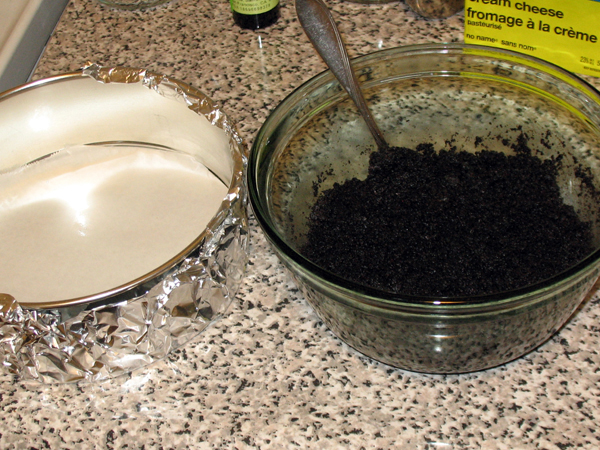
Step 2 – grease springform pan and line bottom with parchment paper. Optional step: line outside of pan with heavy tinfoil to use in bain marie.
Step 3 – mix the cookie crumbs with melted butter:
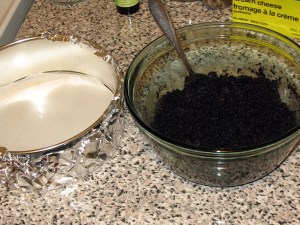
Step 4 – press crumbs firmly into bottom of pan to form crust, bake in oven for 10 minutes AND THEN LOWER OVEN TO 150°C / 300°F.

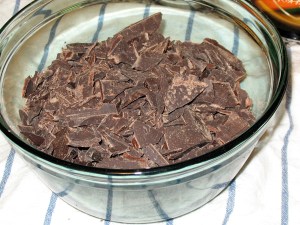
Step 5 – chop chocolate with a serrated blade and set it aside. Er… this was supposed to be 4 oz… but it’s more like 8 or 12. Oops.
Step 6 and 6.5 – gently beat the cream cheese, not too much and not too fast. Try 2 minutes on Low, and continually scrape down the sides of the bowl. I wish I had a Kitchen Aid mixer!
Don’t over-beat because that will add too much air to the mixture, creating air bubbles which collapse during the baking process, causing cracks.
After the cream cheese is beaten, add the sugar and beat until combined.
Then beat in the eggs (one at time), until combined.
Finally beat in the vanilla, and set aside.
Step 7 – melt the chocolate and stir in the Baileys. Normally I melt chocolate in a double boiler to temper it, but that is pointless for a dish destined for the oven. Instead, microwave on High for 30 seconds, stir, repeat until melted.
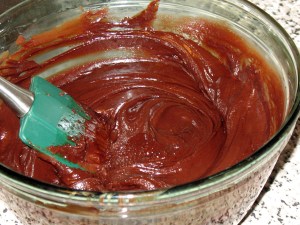
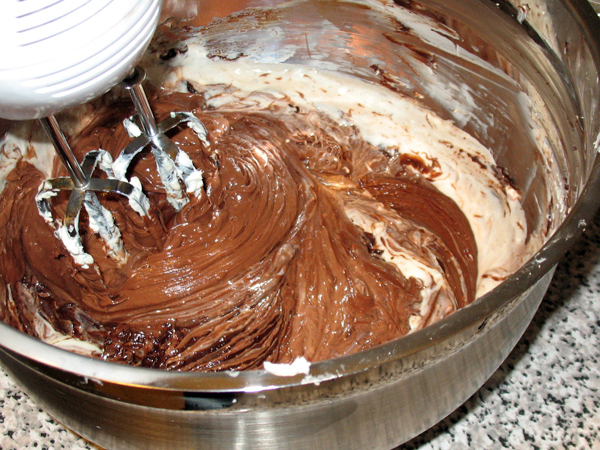
Step 8 – beat chocolate into cream cheese mixture (gently!) I originally was going to use my red mixing bowls, but I read that cream cheese rises up high in the bowl so switched over to a big metal bowl instead.

Step 9 – “pour” mixture onto crust – since I used too much chocolate my filling was very dense, it had to be scooped out of the bowl, smooshed down, and smoothed out. If your filling is normal (runnier), gently shake the pan to even it out and remove air bubbles.
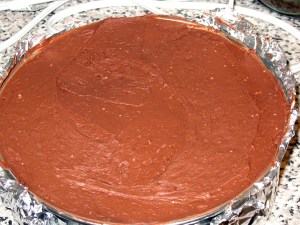
Optional step: I set my springform pan into a 9×13″ baking pan, set that in the oven, and carefully poured hot water from the kettle into the larger pan. This created a hot water bath that rose halfway up the side of the foil-wrapped springform pan. That served 2 purposes: a) prevents top from drying out, b) prevents cracking. The hot water should never come in contact with the ingredients.
Step 10 – DID YOU LOWER THE OVEN TEMPERATURE EARLIER?
Bake cheesecake 50-60 minutes at 150°C / 300°F.
How do you know it’s done? The same way you check custard; gently shake it.
If the entire thing jiggles, give it another 5 minutes and check again.
If the edges are firm but the centre jiggles, it’s perfect.
It nothing jiggles at all it’s overdone.
Step 11 – remove from oven but do not open the springform pan.
Carefully use a frosting spatula or thin blade to loosen the pan away from the cake, go slowly around the edge of the pan, all the way down to the bottom. This will prevent the cake from tearing or collapsing when the spring is released after chilling. Be careful and take your time.
Cool on a wire rack for 1 hour.
The cake will firm up as it cools.
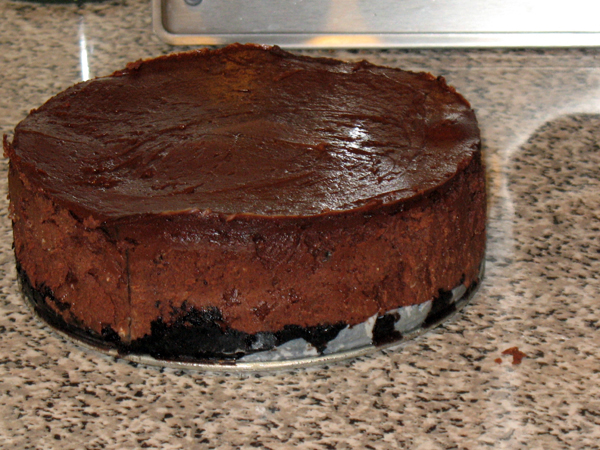
See the dark ring around the bottom of the pan? That’s from the water bath.

Step 12 – cover and refrigerate overnight, or at least for 8 hours
Here’s my cake the next day, see the part in the centre that looks pale? That is where the plastic wrap touched the top. Oops.

Step 13 – remove tinfoil, and very carefully open the latch on the pan, and lift it away from the cake, hopefully it will stay intact:

Step 14 – cut the cake with a sharp, hot knife, cleaning the knife after each cut. This prevents the filling from tearing or getting crumbs on it.
Alternatively, you can use a tight line; unflavoured dental floss, piano wire, or a new piece of fishing line – whatever works for you.
Cut it half, and then into fourths – I got 16 pieces out of this.

Step 15: serve and enjoy! Cheesecake tastes best after standing at room temperature for 30 minutes.

Verdict:
I liked this and will make it again, with some adjustments. The flavour was intense. I finished my slice throughout the day, 2 bites at a time.
I used 1/2 Cup of Baileys and found that was too much, that’s why I say above to use 1/4 Cup. However, the 4 people who have tasted this said the Baileys flavour was just right, so you might need to experiment with this.
Next time, I’ll definitely measure the chocolate more accurately, I need a better kitchen scale. I’ll let the cream cheese sit at room temperature for longer, 40 minutes wasn’t enough. I will also beat the cream cheese more, I was afraid of over-mixing and ended up not mixing enough, there were a few white bubbles in the filling. They tasted fine but were aesthetically irritating.
Overall I’m quite pleased with the result, it was my first cheesecake, and my own recipe, and it turned out wonderfully!












 SpatulaGoddess.com